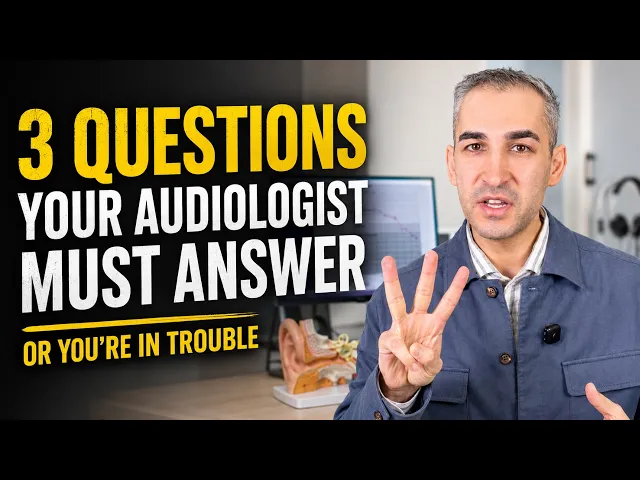

3 Critical Questions That Separate Good Audiologists from Bad Ones
When you take the step to address your hearing health, you deserve more than a simple transaction. You deserve a clear, transparent experience where you fully understand your diagnosis, your treatment plan and what comes next.
Too often, people invest significant time and money into sophisticated hearing devices, only to walk away feeling unsure about how those devices were fitted or what steps to take if they still struggle.
High-quality hearing care is a collaborative partnership between you and your healthcare provider. To help you take charge of your hearing journey, here are three fundamental questions you should expect your audiologist or hearing healthcare provider to answer clearly and thoroughly.
“What Type of Hearing Loss Do I Have, and What Does It Mean for My Everyday Life?”
Your hearing assessment provides crucial insights into how your ears process sound, but raw data alone is not enough. You benefit from receiving a detailed explanation that connects your clinical results directly to your daily communication experiences.
Rather than relying on a broad label like "mild to moderate loss," you gain immense value from understanding the exact nature of your hearing.
Your provider should explain whether your hearing loss is sensorineural (related to the inner ear or nerve pathways), conductive (related to the outer or middle ear blocking sound transmission) or a mixed combination of both.
Understanding the specifics of your condition helps you navigate your overall health:
Symmetry and Balance: You can learn whether your hearing loss is symmetrical (equal in both ears) or asymmetrical (where one ear hears better than the other). Asymmetrical loss often requires specific medical considerations or further investigation.
Frequency and Clarity: Your test demonstrates which specific frequencies you are missing. Missing high-frequency sounds often makes speech sound muffled, meaning you hear the volume of someone's voice while losing the sharp clarity needed to distinguish consonants.
Speech Understanding: Understanding your speech discrimination scores helps explain how well your brain processes spoken words when sound is amplified. This insight ensures your hearing devices are set up to provide clear communication rather than amplifying distorted sound.
Medical Next Steps: Your results reveal whether medical follow-up is necessary. You gain peace of mind knowing whether a visit to your primary care physician or an ear, nose and throat (ENT) specialist is recommended before proceeding with amplification.
When your provider translates your audiogram into practical real-world scenarios, you can better anticipate how your hearing will perform in noisy environments, group conversations and family gatherings.
“How Do You Know My Hearing Aids Are Programmed Correctly for My Unique Ears?”
Every person's ear canal has a distinct shape, volume and acoustic resonance. Because of these physical differences, two people wearing the exact same model of hearing aid will experience completely different sound levels inside their ears.
You receive the best results when your fitting relies on objective, scientific verification rather than automatic initial settings. Manufacturer computer software provides a helpful baseline, but your provider optimizes your care by utilizing real ear measurements (REM).
Real ear measurement is the gold standard for evidence-based hearing aid fittings:
Precision Microphones: Your provider places a small, specialized probe microphone inside your ear canal along with your hearing aid.
Acoustic Measurement: The system measures the precise acoustic output of the hearing aid directly at your eardrum.
Prescriptive Targets: Your provider adjusts the amplification across individual frequencies to match customized prescriptive targets based on your unique ear anatomy and hearing loss profile.
Through real ear measurements, you can rest assured that your hearing aids are accurately delivering the precise amplification needed for your ears.
While comfortable listening adjustments can always be made based on your preferences, starting with verifiable, objective measurements ensures your customized treatment plan has a solid foundation.
“What’s the Follow-Up Plan if I Still Experience Challenges?”
Fitting your hearing aids is the beginning of your hearing rehabilitation, not the conclusion. Your brain requires time to adapt to sounds it may not have processed in years, and navigating new auditory environments takes ongoing support.
You benefit from a structured, guided follow-up schedule that actively supports your adjustment process.
A comprehensive follow-up strategy includes clear expectations for your first few weeks:
Initial Follow-Up Timing: You should expect a dedicated follow-up appointment within two to three weeks of receiving your devices to review your experience and make fine-tuned adjustments.
Tracking Real-World Experiences: You can track the specific environments where your hearing feels significantly improved, as well as situations where you still face difficulty. Observations from family members and close friends also offer valuable feedback for customization.
Natural Living Settings: You gain the most benefit by wearing your devices during your normal daily routine, testing them across various quiet and social environments without forcing unnaturally loud scenarios.
Addressing Specific Comfort Issues: Your follow-up care provides targeted solutions for managing background noise, adjusting your own-voice acoustic comfort (the occlusion effect), alleviating physical ear canal discomfort and managing tinnitus.
When you have a defined follow-up roadmap, you are guided through every adjustment step with confidence and personalized care.
Bonus: “What Are the Realistic Boundaries of Hearing Aid Technology?”
Setting realistic expectations is a fundamental key to long-term success with hearing care. Transparent providers share exactly what hearing devices can achieve, along with their natural limitations.
While modern hearing aids are highly sophisticated communication tools, they do not restore natural hearing function completely.
Understanding that hearing aids significantly improve speech clarity, reduce listening effort and enhance social connection, while acknowledging that extremely noisy environments may still present occasional challenges, allows you to approach your hearing health with realistic, achievable goals.
By asking these key questions, you actively participate in your hearing healthcare, ensuring you receive personalized, evidence-based care tailored to your life.
Ready to get started with trustworthy hearing care providers that will answer these questions and more? Get in touch with us at Port Credit Audiology today to get the expertise, answers and care you deserve.
Frequently Asked Questions (FAQs)
Q: How often should I schedule follow-up appointments after getting new hearing aids?
A: You benefit from scheduling an initial follow-up appointment approximately two to three weeks after your initial fitting. This timeframe allows your brain to adapt to the new sounds while giving you enough real-world experience to identify areas that need fine-tuning.
After your initial trial period and custom adjustments are complete, annual check-ups are recommended to test your hearing, inspect and clean your devices and verify that your programming still matches your needs.
Q: What is the difference between manufacturer software settings and real ear measurements?
A: Manufacturer software relies on standardized mathematical algorithms to estimate how a hearing aid should perform based on your audiogram. However, it cannot account for the specific size, shape and acoustics of your individual ear canal.
Real ear measurements (REM) use a probe microphone placed near your eardrum to objectively measure the exact sound levels inside your ear. This ensures your devices are accurately programmed to customized prescriptive targets specific to your anatomy.
Q: Why do speech clarity and volume differ during a hearing test?
A: Volume refers to how loud a sound needs to be for your ear to detect it, while clarity relates to how clearly your brain interprets spoken words once they are loud enough. Sensorineural hearing loss often damages the delicate hair cells in the inner ear that detect higher frequencies, which supply speech consonants like "s," "f" and "th."
When these frequencies are lost, sound may feel loud enough, but words will lack definition. Identifying your speech discrimination scores helps your provider tailor your treatment to maximize clarity rather than simply increasing overall volume.
Source
Cut the Noise with Dario: Check out more of my YouTube videos here!
Request a Callback
Search